
Lot n° 210
Estimation :
1000 - 1500
EUR
Result without fees
Result
: 1 000EUR
Jean-Gabriel DOMERGUE (1889-1962) - Lot 210
Jean-Gabriel DOMERGUE (1889-1962)
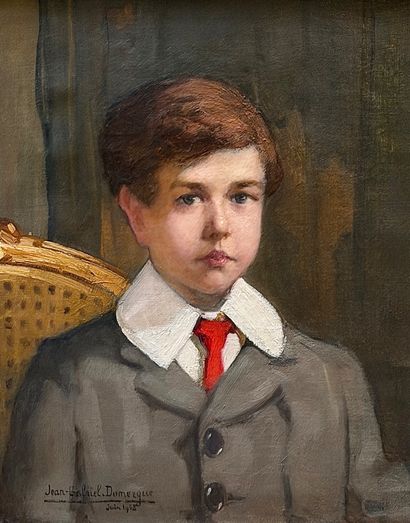
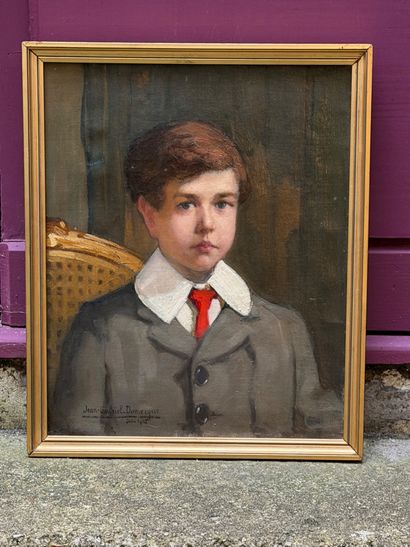
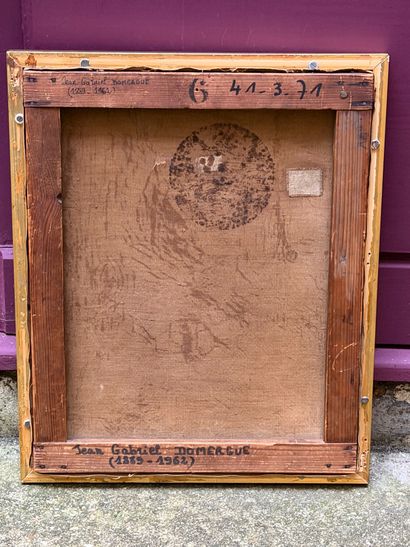
Portrait of a young boy, June 1908
Oil on canvas
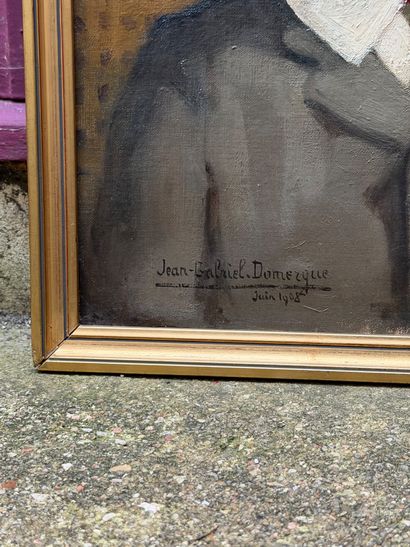
Signed "Jean-Gabriel Domergue" and dated lower left
40 x 32 cm
Framed
THIS LOT WILL BE CONSIGNED TO DROUOT'S WAREHOUSE AFTER THE SALE, IT WILL NOT BE RETURNED. Please refer to the conditions of the auction house concerning the withdrawal of lots before bidding.
NOTICE
Born in Bordeaux, Jean-Gabriel Domergue was an emblematic artist of Paris between the wars. He trained at the Beaux-Arts de Paris in Cormon's studio from 1903. He also frequented the studios of Jules Lefebvre, Tony Robert-Fleury, Jules Adler and François Flameng. Three years later, he exhibited at the Salon des Artistes Français, where he received an honorable mention in 1908. In 1913, he was awarded the Second Prix de Rome for Le Rapsode, then the Salon's Gold Medal in 1920, and subsequently exhibited out of competition.
While he is best known for his depictions of the Parisienne from the 1920s onwards, his earlier period includes a number of paintings and drawings in a more classical vein. In 1901, he produced a Pietà in the church of Saint-Martin-des-Champs in Paris, and a Chemin de croix donated to the church of Saint-Hilaire in Agen. Alongside these religious themes, Domergue also painted portraits, notably La Robe de jonquille (1912).
The 1920s were very productive years for Domergue. His works met with great success, thanks in particular to the depiction of his women in slender, elegant and resolutely contemporary silhouettes, embodying the freedom, grace and modernity of the "new woman". Indeed, the artist claims the title of "inventor of the modern pin-up", so much so does his work celebrate the glamorous, flirtatious woman. His models included Liane de Pougy and Nadine Lhopitalier, the future Baroness de Rothschild, whose grace and voluptuousness he captured. Domergue also produced nudes and semi-nudes - often of young women or dancers - always depicted with elegance and refinement. Most notably, he painted Joséphine Baker nude, perfectly illustrating his taste for the slender, graceful figure.
At the same time, he took an interest in poster art. His compositions, notably for Galeries Lafayette and Monte-Carlo, reflect his influence on the image of the modern, glamorous woman, where fashion and tourism take center stage. He promoted Parisian style and the luxury and refinement of social life. Highly influential in the fashion world, he collaborated with the greatest names of his time, such as Paul Poiret, on the creation of dresses, hats and accessories, helping to define the feminine elegance of his era. He was also a great organizer of spectacular parties, both in Paris and in the provinces, notably in Biarritz, Monte-Carlo and Cannes. This enthusiasm for festivities is reflected in his depictions of the French cancan, where he shows airy, dynamic dancers in daring poses, capturing the movement and energy of the Parisian scene, also honored by Henri de Toulouse-Lautrec. In fact, some of these posters display a graphic sensibility close to that of Lautrec, a discreet echo no doubt due to their kinship, but also to the fact that the latter introduced him to the Moulin-Rouge and its dancers.
Passionate about art in all its forms, between 1955 and 1962 he was also a volunteer curator at the Musée Jacquemart-André, where he organized major exhibitions, notably devoted to Berthe Morisot, Van Gogh and Francisco de Goya.
His instantly recognizable work occupies a singular place in French art of the XXᵉ century, halfway between illustration, worldly portraiture and refined elegance.
My orders
Sale information
Sales conditions
Return to catalogue