

Lot n° 218
Estimation :
10000 - 12000
EUR
Camille PISSARRO (1830-1903) - Lot 218
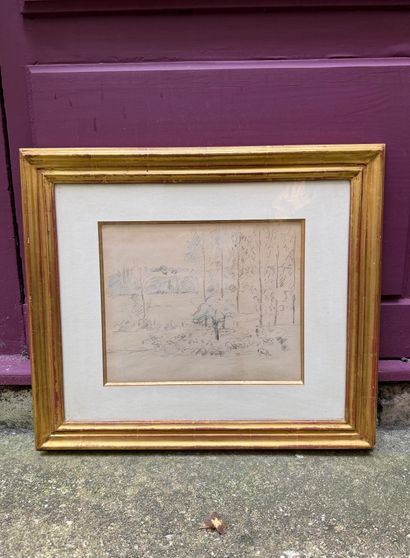
Camille PISSARRO (1830-1903)
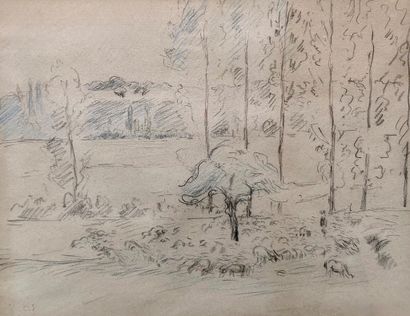
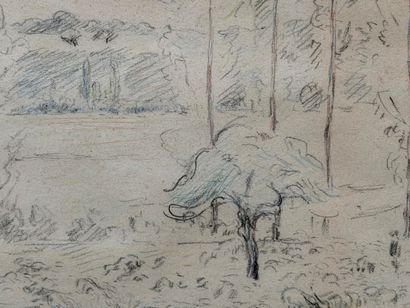
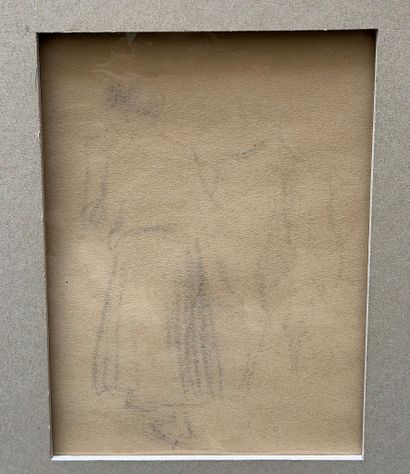
Landscape of Eragny recto, sketch of peasant woman verso
Black pencil and colored pencil
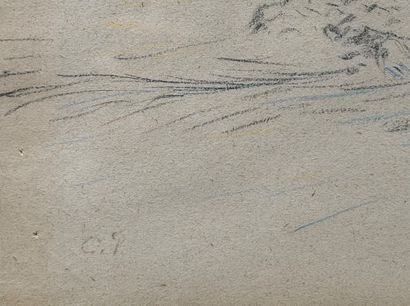
Stamped with the monogram "C.P" lower left
24 x 30 cm
PROVENANCE
Private collection, Paris
June 29, 2022 "Art Moderne" auction, lot 8, MILLON Paris
THIS LOT WILL BE CONSIGNED TO DROUOT'S WAREHOUSE AFTER THE SALE, IT WILL NOT BE RETURNED. Please refer to the conditions of the auction house concerning the withdrawal of lots before bidding.
NOTICE
Nicknamed the "Father of Impressionism", Camille Pissarro arrived in Paris in 1855 to train at the Académie Suisse, where he met Gustave Courbet and Camille Corot, and befriended Claude Monet, Paul Cézanne and Edgar Degas.
His early canvases bear witness to a realist and naturalist influence, notably that of Jean-François Millet, with a focus on peasant life, rural landscapes and natural light. From 1866, his move to Pontoise marked the start of a seminal period: he painted the surrounding villages, fields and rivers, seeking to capture the changing light and atmosphere of everyday life.
In 1870-1871, during the Franco-Prussian war and the Paris Commune, Camille Pissarro went into exile with his family in London. This stay marked a major turning point in his career, both artistically and financially. In the English capital, he met Claude Monet and Alfred Sisley, who became acquainted with the art dealer Paul Durand-Ruel, who had just opened his gallery in New Bond Street. Durand-Ruel was to become his main supporter and distributor for the rest of his career. It was also in London that Pissarro discovered the landscapes of Turner and Constable, whose study of skies, light and atmospheres was to have a profound influence on the way he painted nature and dealt with light in his Impressionist landscapes. Among the works born of this stay is The Avenue, Sydenham (1871), testimony to an artist confronted with a new urban landscape and new techniques, while also laying the foundations for his future recognition thanks to the support of Durand-Ruel.
Back in France, Pissarro returned to Louveciennes only to find his house looted, an event that had a lasting effect on him. In 1872, he decided to settle in Pontoise.
Between 1874 and 1886, Pissarro took part in eight Impressionist exhibitions, becoming the only member of the group to attend them in their entirety. He refined his plein-air technique, exploring the seasons and the effects of light, while depicting rural life and suburban landscapes. Among his emblematic works from this period, A Cowherd at Valhermeil, Auvers-sur-Oise (1874) illustrates his attention to detail, sensitivity to atmospheric nuances and ability to capture everyday life with authenticity. In the 1880s, he briefly experimented with pointillism under the influence of Georges Seurat and Paul Signac, adopting a juxtaposition of colored touches intended to produce an optical blending effect, before returning to a freer, more personal touch, faithful to his vision of reality.
From 1884 onwards, Camille Pissarro settled in Éragny-sur-Epte, in the Oise region, where he remained until his death in 1903. This was undoubtedly one of the most accomplished and consistent periods of his career, marked by a meticulous study of the surrounding countryside. In Éragny, Pissarro mainly painted the countryside, orchards, fields, villages and hamlets, capturing the effects of light and atmosphere according to the seasons, the weather and the time of day.
Life in Éragny also enabled him to produce thematic series, such as orchards in spring, summer or autumn, offering subtle variations in light and color, but also views of hamlets in the snow or rain, always treated with observant meticulousness and a concern for balance.
Emblematic works from this period include Le Verger à Éragny (1898), La Moisson à Éragny (1901) and Le Chemin de la Machine à Éragny (1890).
Pissarro opened up to new subjects, especially urban views. From the windows of hotels and apartments, he painted Paris and its boulevards, capturing the movement of the streets and the bustle of the city, while retaining his interest in light and changing atmospheres. Works such as Boulevard Montmartre, matin d'hiver (1897) and Le Jardin des Tuileries, un après-midi d'hiver (1899) testify to his ability to simultaneously capture urban dynamism and subtle lighting effects.
His work influenced many artists and helped spread the pictorial innovations of his time. He left behind a rich and varied body of work, at the crossroads of
My orders
Sale information
Sales conditions
Return to catalogue